
Medical Engineering Modeling Ontology
Safety evidence should stay true when the system changes.
A SysML v2-native ontology and toolchain that keeps a medical device's safety evidence aligned as the design changes — typed, computable, and architecture-backed.
The problem
The artifacts remain. The meaning drifts.
Risk files, requirements, architecture notes, tests, and release records change on different cadences. After a design change, teams must still defend one complete thread: what changed, what it affects, where the control is implemented, and which evidence is still fresh.
A trace link often says only that two things are related — not how. A requirement "traces to" a test, but does the test verify the requirement, the implementation, or a risk control? Generic links cannot carry that distinction.
The answer
Architecture-backed safety threads.
meMO makes the safety argument explicit and checkable. Every node is typed. Every edge is a semantic link with a verb, roles, and status. Change impact is computed from typed relationships, not reconstructed from meeting memory.
Architecture + assurance
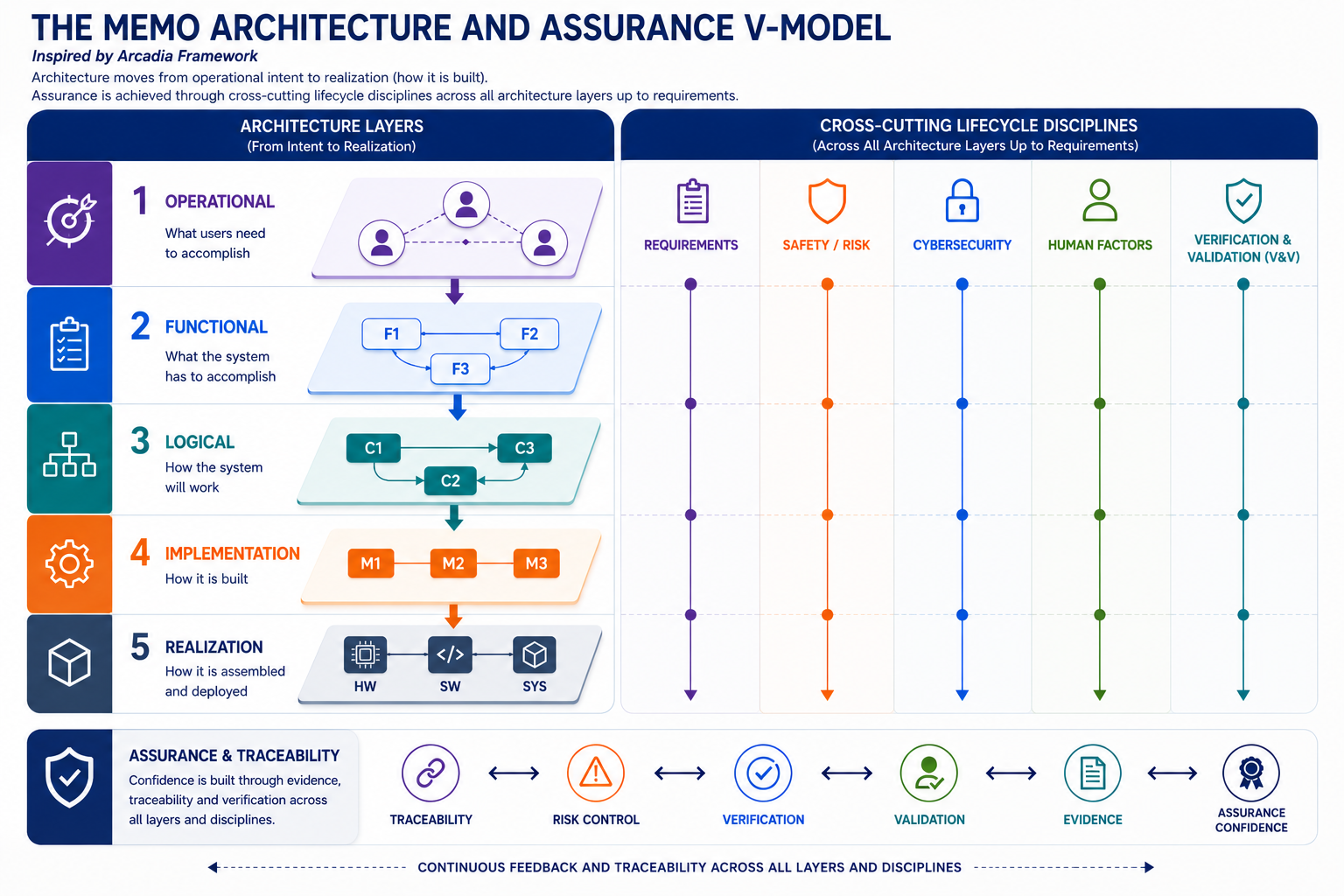
One model, two connected dimensions.
Operational intent moves through functional, logical, implementation, and realization layers while assurance disciplines connect across the lifecycle.
The stack
Four parts, adopt what you need.
Ontology
Typed SysML v2 elements and Arcadia-inspired architecture layers for safety, interfaces, behavior, hardware/software, and evidence.
Pre-release · reviewMethodology
Predefined viewpoints, rules, workflow stages, review gates, and project bindings. A working structure to start from.
Pre-release · reviewTools
Parser, validator, and CLI that check the model and generate documents. Run memo validate in CI.
Architect
A web app for diagrams, traceability, DSM, and DHF review. Six modes over the same source model.
Pre-release · reviewStandards coverage
Built for regulated medical devices.
ISO 14971
Hazards, harms, risk controls, risk matrices, residual risk, risk management file views, and closure rules for hazard-control-verification chains.
IEC 62304
Safety classification (A/B/C), software architecture layers, verification obligations, and lifecycle-stage scoping.
ISO/IEC/IEEE 42010
Architecture viewpoints, views, stakeholder concerns, and architecture decisions.
IEC 81001-5-1
Cybersecurity threat modeling, trust boundaries, vulnerability/mitigation links, and impact-on-safety connections.
Resources
Learn, explore, contribute.
Presentations, source code, and documentation to get started with meMO.
Presentations
Source code
memoarchitect/memo
Portable SysML v2 ontology and methodology source, including the GPCA pump reference model. MIT licensed.
memoarchitect/memo-tools
Parser, semantic model, validation engine, project operations, and command-line tooling.
memoarchitect/memo-architect
Visual workbench for diagrams, traceability, scenarios, DSM, validation, and DHF review.
Documentation
Choose the guide for the product you are using. The ontology defines the model; Tools checks and generates from it; Architect provides review views over that same source.
MEMO Ontology guide
Learn the SysML v2 vocabulary, layers, relationships, and worked medical-device modeling examples.
MEMO Tools guide
Parse the model, run validation and closure checks, generate artifacts, and use the CLI in CI.
MEMO Architect guide
Explore the visual workbench for diagrams, traceability, scenarios, DSM, and DHF review.
Create. Compile. Assure.
Author the model, compile the checks, and keep the safety case assured as the design changes.